
Meet Magento UK 2026 - a story of community, ownership, AI and much more
09.07.2026 6 min. 460 views
Meet Magento is the largest international series of independent conferences dedicated to the Magento and Adobe Commerce ecosystem, bringing together merchants, developers, technology partners and eCommerce experts from around the world.
This year marked the ninth edition of Meet Magento UK, featuring the largest number of speakers in the conference’s history, excluding the online editions held during the COVID pandemic.
We are regular attendees of the conference, and this was our third consecutive visit to the UK edition. Unlike Meet Magento Netherlands, where the focus was on the development of Hyvä and the latest updates around it, the London conference offered a broader perspective on the evolution of eCommerce and the Magento ecosystem as a whole.
This matters because many new technologies and trends come from across the Atlantic, and the UK is often their first stop on the way to Europe.
Without trying to recreate the atmosphere of the conference and the conversations we had there, in this article we will share some of the key takeaways and useful updates from our favourite ecosystem, based on the wide range of presentations and discussions we took part in.
How is Magento evolving in 2026?
In 2026, Magento is evolving towards greater fragmentation, flexibility and full ownership of merchants’ digital assets.
After several years in which changes across the ecosystem seemed mostly evolutionary, this year’s edition surprised us with an exceptional number of updates and new directions. Among all the topics, however, one stood out the most and strongly reflected a principle Stenik has believed in since the very beginning: ownership.

At a time when most platforms lock in merchants and users, close their code and introduce more and more restrictions, the opposite is happening in this ecosystem: more fragmented and better solutions are emerging to support a more open approach to eCommerce. Instead of offering a single one-size-fits-all platform, it provides a rich ecosystem of companies, technologies and products that allow every business to build a solution around its specific needs.
This freedom of choice, transparency and genuine platform ownership remain some of Magento’s strongest advantages and one of the main reasons why so much innovation continues to happen within this ecosystem.
Some of the solutions driving this development include:
- Magento Open Source - continues to evolve as a leading open-source eCommerce platform chosen by global brands
- Mage-OS - continues to strengthen its role as an independent, community-driven project that helps ensure the Magento ecosystem remains open, transparent and managed in the best interests of the community and merchants.
- Adobe Commerce - serves the needs of large enterprise businesses and continues to develop this segment. Adobe Commerce has accelerated the implementation of AI assistants in the platform’s backend.
- Hyvä and Hyvä Commerce - are just some of the solutions available to businesses that choose this ecosystem. Depending on the company’s needs, they offer different approaches and opportunities for growth.
- Magento Association - the organisation continues to gain momentum and play an increasingly important role in the development of the community.
As part of the ecosystem and our commitment to supporting the development of the global community, in 2026 Stenik officially became a member of the Magento Association. This membership gives us even more direct access to knowledge, best practices and professionals who actively contribute to the development of the platform - an advantage we bring directly into the projects and solutions we deliver for our clients.
What is the secret behind leading online retailers?
The secret behind large and successful online retailers lies in a consistent approach to platform development through gradual improvements and a relentless focus on simplifying the user experience (UX). Instead of risky and expensive full redesigns, leading brands rely on continuous optimisation based on real data and A/B testing.
Major updates do not always deliver major results
Large-scale eCommerce updates - meaning a complete replacement of the customer-facing storefront - often fail to deliver the expected results. More and more agencies recommend long-term work built around step-by-step, incremental changes supported by A/B testing, rather than major one-off redesigns. Interestingly, this approach has been used by the biggest players, such as Amazon, for decades. Yet it is still difficult to access for small, medium-sized and even larger merchants that do not have their own in-house teams and often hear the same promise from the next agency they approach: “We will migrate your store and solve all your problems.”
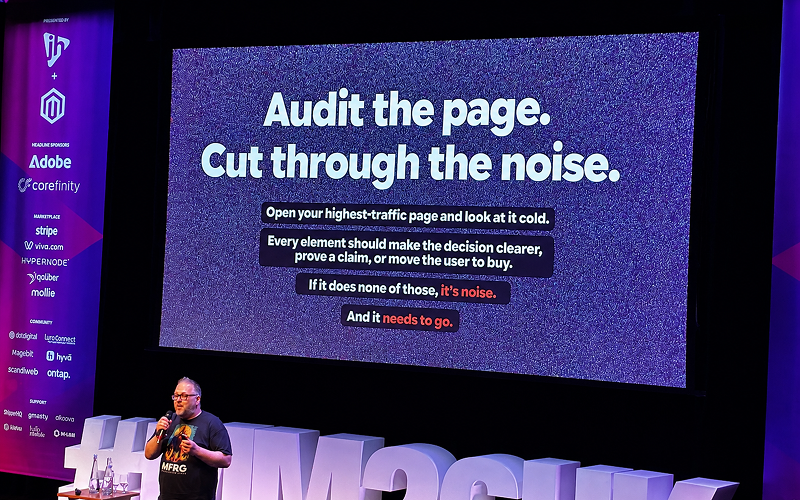

Removing the noise
In the age of AI-generated designs and so-called “best practices”, one message aimed at UX/UI designers stood out to us in particular:
Any element that does not help the user make a purchase decision, provide proof for a claim or encourage the user to buy sooner through urgency is simply noise!
It is time to redesign outdated product pages that try to communicate everything at once.
What is the real role of artificial intelligence (AI) in eCommerce?
Artificial intelligence was undoubtedly one of the most widely discussed topics at the conference. Despite the many demos and new solutions, the main message was far more pragmatic than the usual hype surrounding AI.
We particularly liked a phrase shared by Ben Marks (welcome back, legend!):
“AI is a multiplier of the value you create. If your value is 0, applying AI still leaves it at 0.”
AI shopping assistants - agentic commerce in the true sense of the term - remain largely theoretical, not only in Europe but also in the US market, and are still mostly present in the minds of investors, speculators and eCommerce dreamers. At the same time, their potential in B2B commerce is significant because purchases are often repetitive and predictable, while it is much more limited in impulse-driven retail, where customers tend to shop with their eyes.

Another thought that stayed with us after the conference was:
“AI gave us speed. Now someone needs to give us brakes.”
This was probably one of the most accurate descriptions of the mature approach to AI presented at the conference.
An interesting study - one of many on the subject - showed that more than 90% of CEOs expect AI to improve efficiency, while at the same time 77% of employees who use it report that it increases the time needed to complete tasks because of the endless options, checks and refinements AI makes possible.
AI can significantly increase the value we create, but only when it is supported by a clear strategy, expertise and the right balance. We do not need brakes to stop us, but to help us stay in control.
FAQ
Conclusion
Meet Magento UK 2026 confirmed that the preferred eCommerce platforms are those that provide freedom, flexibility, room for unrestricted growth and genuine control over digital assets.
If we had to sum up the conference in one word, it would be “freedom”. The freedom to choose your technologies, own your platform and grow your business without restrictions within a stable ecosystem.
For more than 20 years, the Stenik team has helped businesses from different industries and of different sizes build sustainable eCommerce solutions. We closely follow the development of the global Magento community, actively contribute to it and apply leading international practices in our clients’ projects.
If you are planning to build a Magento online store, migrate to Magento or Adobe Commerce, or are looking for a technology partner that can adapt proven international practices to the specific needs of your business, we would be happy to discuss how we can help you build your online store. Contact us for a consultation.
Published in:
Events & Presentations